Festival Card Designs and Prices
Compare the four card tiers. The prices below come from the same Festival pricing class used by the choice and payment pages; visit the full comparison for the current features.
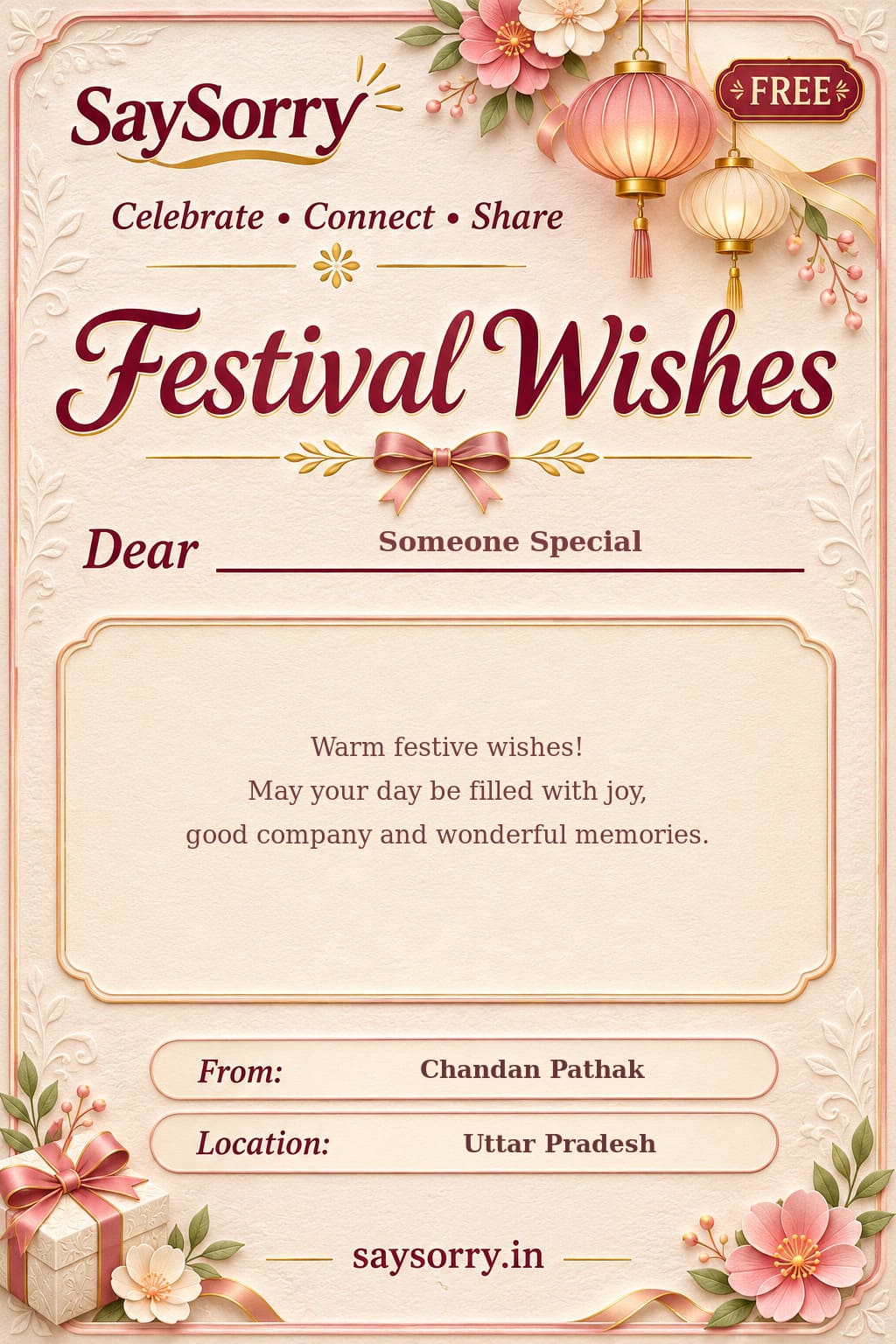
Free
₹0
A soft ivory festival card with room for a personal greeting.
Create Free card
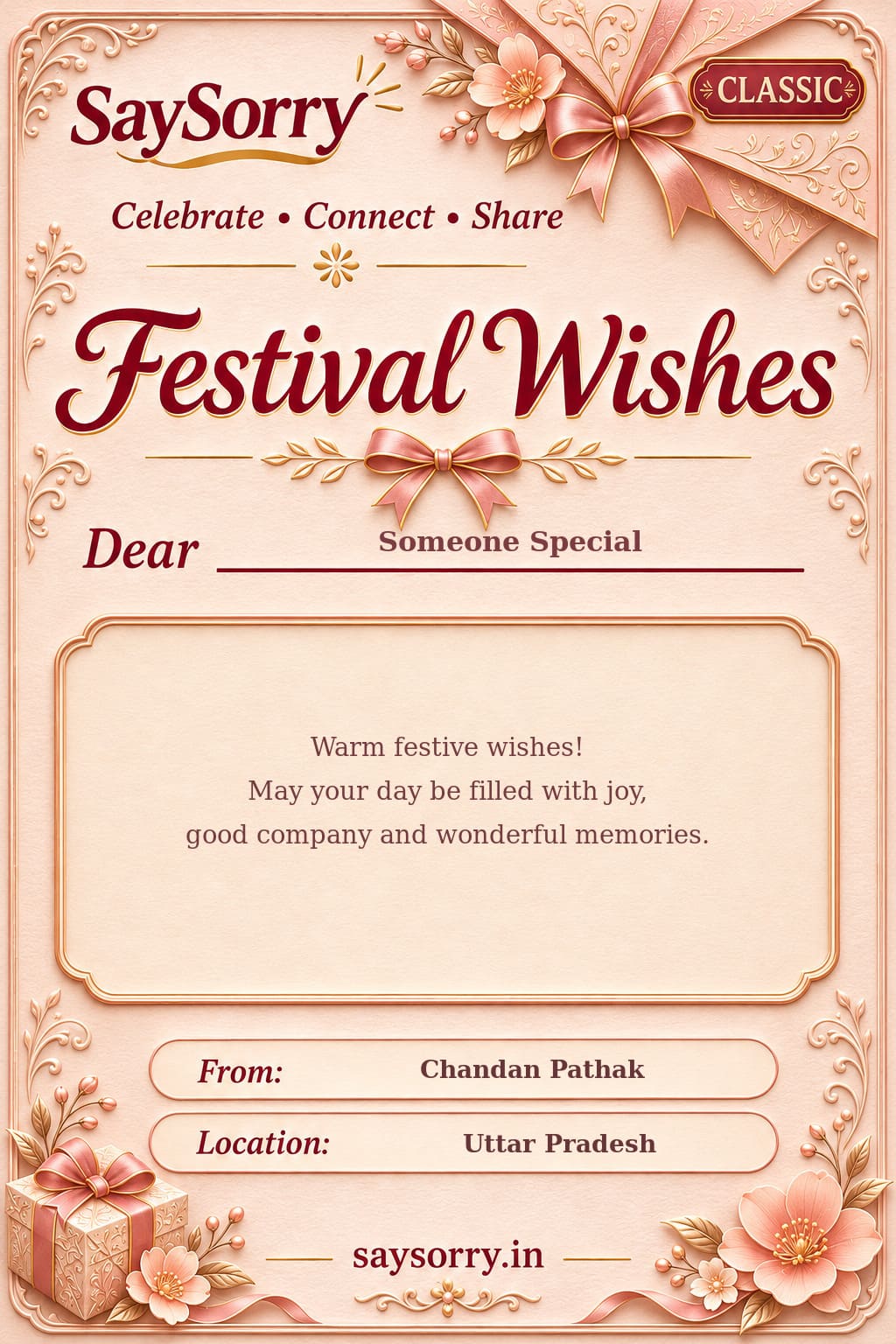
Classic
₹50
A rose-gold celebration design with the Classic card features.
See Classic design
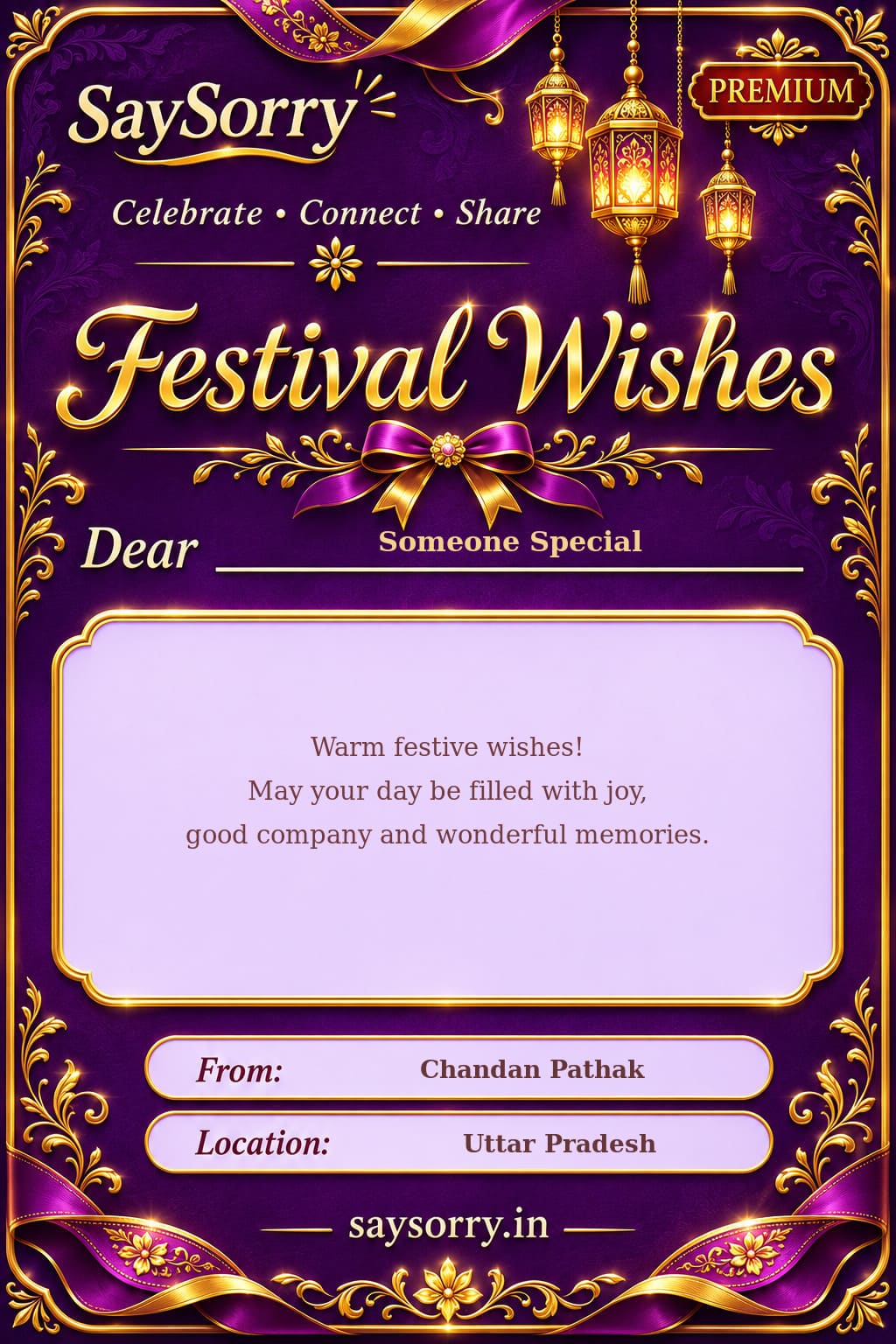
Premium
₹100
A violet-and-gold card with the Premium animated experience.
See Premium design
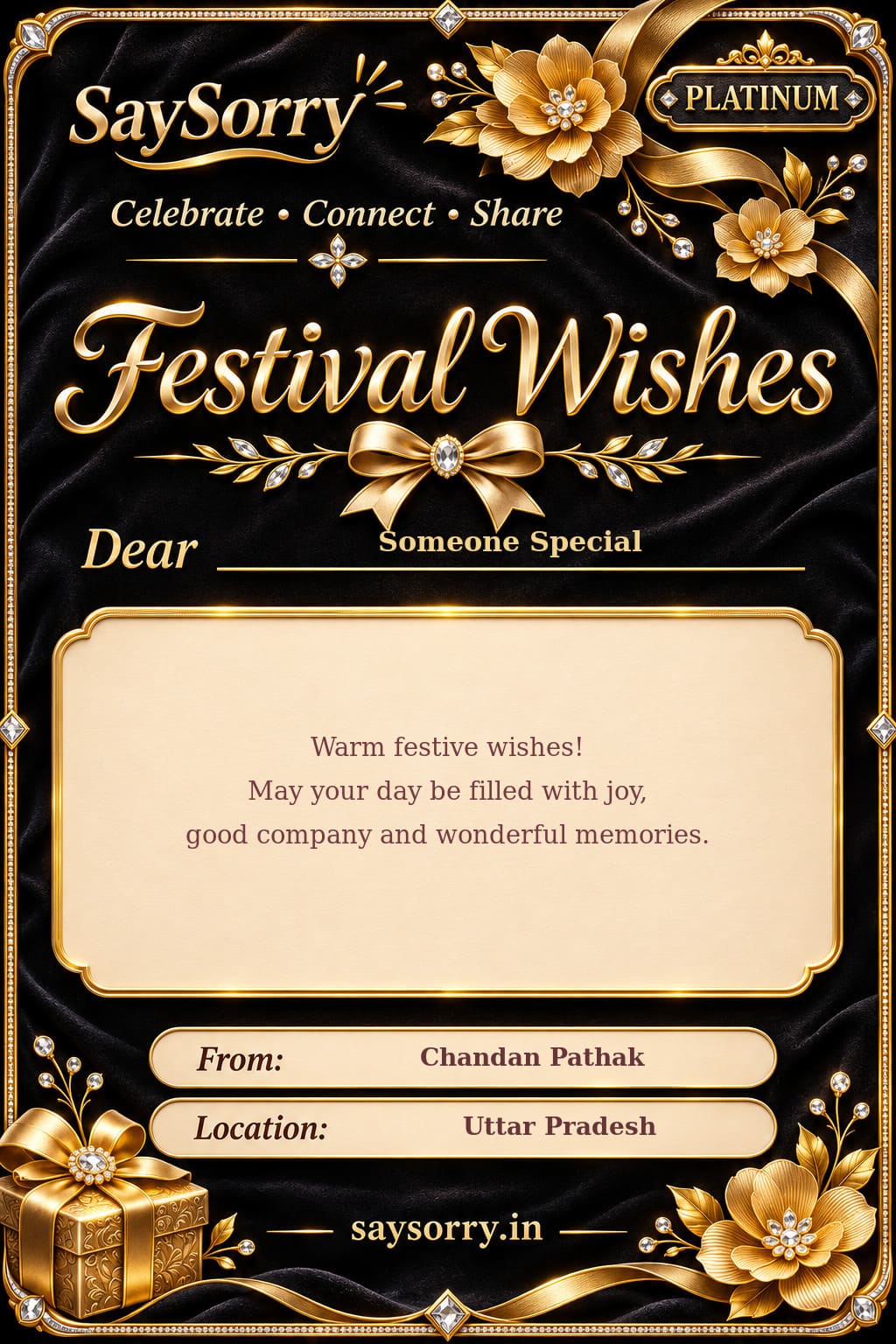
Compare all Festival Card plans
Choose Your Festival
Each festival has its own message examples and advice. Choose the actual occasion rather than changing only the festival name in an unrelated greeting. Eid al-Fitr and Eid al-Adha have separate guides, and the New Year page keeps dates out of the reusable card until you deliberately add them.
Diwali wishes for a personal greeting
A Diwali message can feel bright without promising that every problem will disappear. Wish the recipient a peaceful home, enjoyable company or a fresh beginning that matters to them. A personal card can mention the conversation you hope to have when you meet; a business greeting should recognise the relationship without turning the festival into a sales pitch.
Think about the person opening the card. A friend may enjoy a light reference to choosing sweets together. Parents may appreciate a wish for an unhurried evening after the preparations. For a colleague, keep the greeting warm and inclusive without assuming how their household observes the occasion. If you are not sure which greeting they prefer, Happy Diwali is a simple opening.
Happy Diwali! May your evening have good company, a peaceful pause and something delicious to share.
दीपावली की हार्दिक शुभकामनाएँ। आपके घर में अपनापन, मन में सुकून और साथ बिताने के अच्छे पल बने रहें।
Avoid a message that assumes everyone buys new things, hosts a large gathering or celebrates in the same way. A small celebration deserves the same warmth. Let the card offer companionship rather than pressure to make the day spectacular.
Read Diwali wishes in English, Hindi and Hinglish
Holi wishes for a personal greeting
A Holi wish can be playful, colourful or simply kind. Choose the tone from your relationship rather than assuming every recipient wants a noisy celebration. A cheerful card can send the feeling of a shared afternoon even when you are far away, while a professional note can stay warm without mentioning personal plans.
For a close friend, a light memory of laughing together can work better than a list of bright colours. For family, wish for a comfortable get-together and time to reconnect. For a customer or colleague, send a direct greeting and include the organisation name only if you are authorised to speak for it. The words should be enjoyable to read even without the image.
Happy Holi! Here is to a day with more laughter than plans and company you are glad to see.
होली की शुभकामनाएँ! रंगों के साथ हँसी, अपनापन और अपनी पसंद के लोगों का साथ भी मिले।
Do not make the message an excuse to cross a boundary. Avoid jokes about unwanted touching, surprise visits or pressuring someone to participate. You can wish them a lovely Holi whether they celebrate outdoors, at home or quietly.
Read Holi wishes in English, Hindi and Hinglish
Eid al-Fitr wishes for a personal greeting
An Eid al-Fitr card can send warmth to family, friends and colleagues without borrowing a religious voice that does not feel like yours. A simple Eid Mubarak, followed by a considerate wish for the recipient and those close to them, is a meaningful place to begin. Keep personal details accurate and the tone respectful.
If you are writing to someone you know well, mention looking forward to a conversation, a visit you have agreed or a shared meal if that is part of your actual plans. In a workplace card, address the recipient or team directly and leave out assumptions about fasting, travel or family arrangements. The greeting does not need to explain the festival to the person receiving it.
Eid Mubarak! Wishing you a peaceful celebration and happy moments with the people dear to you.
ईद मुबारक! आपको और आपके अपनों को सुकून, खुशियाँ और साथ बिताने के अच्छे पलों की शुभकामनाएँ।
Do not guess the local celebration date or combine Eid al-Fitr and Eid al-Adha as though they are the same occasion. Check the festival selected in the creator. Keep any religious wording within language you understand and are comfortable sending.
Read Eid al-Fitr wishes in English, Hindi and Hinglish
Eid al-Adha wishes for a personal greeting
For Eid al-Adha, choose a respectful greeting that centres goodwill, care and companionship. You can write warmly to a friend or send a simple professional note without making assumptions about how the recipient observes the occasion. Name the festival accurately and keep any personal memory relevant to your own relationship.
A family card may include wishes for time together and consideration for those who cannot join. A friend’s message can offer a call or visit if it is genuinely welcome. A business greeting is usually clearer when it avoids promotional language and simply wishes the recipient and their team a meaningful celebration. Use the preferred spelling of names in every version.
Eid Mubarak on Eid al-Adha. Wishing you a meaningful day, generous company and peace of mind.
ईद-उल-अज़हा की हार्दिक शुभकामनाएँ। आपके और आपके अपनों के लिए सुकून, अपनापन और भलाई की कामना है।
Avoid graphic imagery, unfamiliar religious claims or treating the occasion as a generic party. Do not reuse an Eid al-Fitr date or message that refers to the wrong occasion. If you want to include a prayer, choose words you understand and that suit the recipient.
Read Eid al-Adha wishes in English, Hindi and Hinglish
Christmas wishes for a personal greeting
A Christmas card can be cosy, cheerful, reflective or faith-based depending on the person receiving it. Start with the greeting that fits their celebration, then add a real personal detail. You do not need to assume snow, expensive gifts or a large family gathering to send a thoughtful message.
For a friend, mention a tradition you actually share or something you hope to do together. For someone spending the day quietly, offer warm company without insisting they must feel festive. A workplace note can acknowledge Christmas directly for recipients who celebrate it and use wider season’s greetings when writing to a mixed audience. Let the audience guide the wording.
Merry Christmas! Wishing you a comfortable day, kind company and a moment to enjoy your own favourite tradition.
क्रिसमस की शुभकामनाएँ! आपका दिन अपनापन, सुकून और अपनी पसंद की छोटी खुशियों से भरा हो।
Avoid assuming everybody has time off, celebrates Christmas religiously or has a happy family gathering planned. Do not promise a visit or gift that has not been arranged. A caring simple card is better than an imagined perfect holiday.
Read Christmas wishes in English, Hindi and Hinglish
New Year wishes for a personal greeting
A New Year wish can look ahead without demanding that somebody reinvent their life. Recognise what the recipient hopes for: a fresh project, a calmer routine, a chance to reconnect or simply a more manageable year. Keep the greeting evergreen unless you are deliberately writing a year-specific card.
For family or a close friend, notice a hope they have mentioned rather than assigning a resolution to them. For customers and colleagues, recognise the past collaboration and offer a thoughtful wish for what comes next. A New Year message can be optimistic while leaving room for a year that contained grief, change or uncertainty. Avoid claiming that every experience was wonderful.
Happy New Year! Wishing you room for good ideas, worthwhile rest and the people who help you feel like yourself.
नव वर्ष की शुभकामनाएँ। नए साल में अपने सपनों, आराम और अच्छे रिश्तों के लिए जगह मिले।
Check the year before adding it to the message. Do not carry an old year into a reusable template, promise guaranteed success or tell someone that a new date automatically fixes a difficult situation. Modest encouragement can be more supportive than a sweeping prediction.
Read New Year wishes in English, Hindi and Hinglish
Raksha Bandhan wishes for a personal greeting
A Raksha Bandhan message can celebrate sibling affection without assigning all the responsibility to one person. A shared joke, an honest thank-you or a memory of showing up for each other gives the card its warmth. Write for the relationship you actually have, including siblings celebrating from different places.
A brother’s card can recognise listening, humour and practical support rather than only protection. A sister’s card can celebrate her voice, choices and companionship beyond a family role. If the greeting is for a cousin or another person you celebrate with, use that real form of address. A personal detail should feel welcome, not like a reminder of an obligation.
Happy Raksha Bandhan! Here is to the jokes we both understand and the support that goes both ways.
रक्षा बंधन की शुभकामनाएँ! हमारी नोकझोंक अपनी जगह, पर एक-दूसरे का साथ हमेशा खास है।
Avoid describing a sister as helpless or a brother as responsible for every decision. Keep teasing kind, and do not turn the greeting into pressure about gifts, visits or family expectations. Mutual care is a warmer foundation for the message.
Read Raksha Bandhan wishes in English, Hindi and Hinglish
Navratri wishes for a personal greeting
Navratri wishes can be devotional, joyful or quietly respectful. Choose the language that fits the recipient’s observance rather than assuming a particular region, gathering or routine. A card can wish for strength, peace and meaningful time with others without claiming a specific ritual or festival date.
For family, a familiar form of address can make a short blessing feel personal. For friends, mention enjoying the season together if you have genuinely arranged it. For a professional audience, send an inclusive greeting to those celebrating and avoid guessing who fasts or attends an event. The right message honours the occasion without making every household’s celebration identical.
Happy Navratri. Wishing you a season of strength, peace and moments that feel meaningful to you.
नवरात्रि की हार्दिक शुभकामनाएँ। आपके जीवन में साहस, मन में शांति और अपनों का साथ बना रहे।
Do not assume that all recipients celebrate with dancing or observe the same practices. Keep devotional references accurate to what you intend to say, and remove details you cannot verify. This evergreen guide deliberately does not publish a year-specific calendar.
Read Navratri wishes in English, Hindi and Hinglish
Durga Puja wishes for a personal greeting
A Durga Puja greeting can carry the warmth of meeting, remembering and celebrating without assuming a single way of observing the occasion. Write to the person, not to an imagined crowd. A family card may be affectionate, a friend’s note cheerful and a professional greeting simple and respectful.
If you share a real festival memory, mention one small detail rather than narrating an entire celebration. A conversation during a visit, a familiar meeting place or the wish to catch up again can make the card recognisable. For someone celebrating far from familiar people, send company through your words without insisting that being away must feel sad.
Warm wishes for Durga Puja. May the occasion bring courage, companionship and time to enjoy your celebration.
दुर्गा पूजा की हार्दिक शुभकामनाएँ। साहस, अपनापन और यादगार मुलाकातों के अच्छे पल मिलें।
Do not mix an unverified date, regional custom or unfamiliar phrase into the card merely to make it sound authentic. Use words you understand, spell the recipient’s name accurately and keep any specific plans truthful.
Read Durga Puja wishes in English, Hindi and Hinglish
Janmashtami wishes for a personal greeting
Janmashtami wishes can be devotional or simply send respectful festive goodwill. Choose the form that belongs naturally in your relationship. A greeting does not need a complicated religious quotation to feel meaningful; familiar words about peace, joy and kindness can be enough.
For parents or elders, a respectful greeting and a personal sign-off can carry the whole message. For a friend, add a warm thought about the day they are celebrating. For colleagues or customers, address those observing the occasion without assuming everyone shares the same beliefs. Keep personal prayers separate from claims about guaranteed outcomes.
Happy Janmashtami. Wishing you a peaceful celebration and joy in the small, kind moments of the day.
जन्माष्टमी की हार्दिक शुभकामनाएँ। आपके मन में शांति और घर में स्नेह भरे पल बने रहें।
Avoid invented scriptural quotations or presenting an unfamiliar phrase as a verified religious teaching. If you include a devotional expression, use one you know and intend. Festival greetings are wishes, not promises that a particular result will follow.
Read Janmashtami wishes in English, Hindi and Hinglish
Ganesh Chaturthi wishes for a personal greeting
A Ganesh Chaturthi card can offer warm wishes for a meaningful beginning without promising that every obstacle will disappear. Keep the greeting respectful and personal to the recipient. A short devotional note, a family wish or an inclusive professional message can each suit a different audience.
If you know the recipient’s preferred form of greeting, use it naturally. A close family card may include a familiar expression and affection for everyone at home. A colleague’s card can simply wish a peaceful celebration to those observing the occasion. Mention a new project only if the recipient has shared it and would welcome the connection.
Happy Ganesh Chaturthi. Wishing you a meaningful celebration and a thoughtful start to the plans ahead.
गणेश चतुर्थी की हार्दिक शुभकामनाएँ। आपके अच्छे संकल्पों को हौसला और मन को शांति मिले।
Do not claim that sending or receiving a card guarantees wealth, success or a religious benefit. Avoid adding unfamiliar chants or festival dates without checking them. The greeting should convey goodwill, not create an obligation to forward it.
Read Ganesh Chaturthi wishes in English, Hindi and Hinglish
Chhath Puja wishes for a personal greeting
Chhath Puja wishes should be respectful of the people observing the occasion and considerate of the time and care involved. A card can send affection, peace and good wishes without giving ritual instructions. Use the form of address you share with the recipient, especially when writing to elders or family members.
A personal greeting can acknowledge that you are thinking of those at home or sending wishes from another city. If you offer practical help, make it something you can actually arrange rather than a vague promise. A professional message can simply send respectful Chhath greetings to those observing the occasion and leave personal observances private.
Warm wishes on Chhath Puja. May the occasion bring peace to your home and meaningful time with your loved ones.
छठ पूजा की हार्दिक शुभकामनाएँ। आपके घर में शांति, मन में आस्था और अपनों का स्नेह बना रहे।
Avoid presenting the guide as instruction for rituals, fasting or health decisions. Do not guess observance dates or assume every member of a household participates in the same way. Keep the message centred on respect and goodwill.
Read Chhath Puja wishes in English, Hindi and Hinglish
Makar Sankranti wishes for a personal greeting
A Makar Sankranti greeting can wish for warmth, connection and a cheerful start to the season. Keep regional details personal to the recipient rather than assuming everybody celebrates with the same food, activity or name. A straightforward festival wish works well when you are not sure of a household’s traditions.
For family, a familiar seasonal memory can make the card feel close. For a friend, a simple wish and an invitation to talk may be enough. A professional note should stay inclusive and avoid a sales message disguised as a blessing. If the recipient celebrates a related regional occasion, use the festival name they prefer rather than treating all greetings as interchangeable.
Happy Makar Sankranti! Wishing you warmth, good company and a few cheerful moments to carry into the season.
मकर संक्रांति की शुभकामनाएँ। रिश्तों में मिठास, घर में अपनापन और दिन में कुछ सुकून भरे पल मिलें।
Do not copy a calendar date into the evergreen card unless you have checked it for the intended year and place. Avoid unsafe activity suggestions or language that pressures the recipient to follow a particular custom. A considerate wish leaves room for their own celebration.
Read Makar Sankranti wishes in English, Hindi and Hinglish
Pongal wishes for a personal greeting
A Pongal message can convey gratitude for shared effort, a warm home and the people who make a celebration meaningful. Keep the greeting grounded in the recipient’s own life. A thoughtful card does not need to invent a rural setting or assume that every person receiving it works in agriculture.
For a family card, recognise a gathering or a familiar tradition only when it is part of your real connection. For friends living away from home, a warm greeting can send companionship without assuming they must be unhappy. A customer or colleague may appreciate a clear professional wish that recognises the occasion while leaving personal arrangements private.
Happy Pongal! Wishing you a warm celebration and time to appreciate the people sharing it with you.
पोंगल की हार्दिक शुभकामनाएँ। आपके घर में अपनापन और साथ मिलकर मनाने की खुशी बनी रहे।
Avoid turning the festival into a generic wealth promise or adding customs you do not understand. Use Happy Pongal as a simple greeting when that feels natural, and keep any more specific wording accurate to the person you are addressing.
Read Pongal wishes in English, Hindi and Hinglish
Baisakhi wishes for a personal greeting
Baisakhi wishes can be cheerful and respectful without assuming a single setting for the celebration. Think about the recipient’s own connection to the occasion, then choose a warm greeting they will recognise. A personal message can be lively; a professional one can remain simple and sincere.
A friend’s card might look forward to meeting or recall a celebration you actually shared. A family note can send affection to people at home. For colleagues and customers, offer wishes to those celebrating without assigning religious practices or personal plans to them. If you use a regional phrase, choose one you understand and check the spelling.
Happy Baisakhi! Wishing you an uplifting day, warm company and time to enjoy the celebration.
बैसाखी की हार्दिक शुभकामनाएँ। अपने लोगों के साथ हँसी, अपनापन और अच्छे पलों का समय मिले।
Do not assume everyone receiving the card is a farmer or celebrates with the same activity. Avoid claims of guaranteed prosperity and unnecessary dates. The purpose of the note is to offer goodwill and connection, not explain the recipient’s own festival back to them.
Read Baisakhi wishes in English, Hindi and Hinglish
Onam wishes for a personal greeting
An Onam greeting can send the feeling of welcome, gathering and shared enjoyment without assuming everyone celebrates at home. Choose an affectionate note for family, a cheerful message for a friend or a respectful professional wish. The card should recognise the person as well as the occasion.
If a familiar meal, visit or family gathering is part of your actual shared story, one small detail can make the note personal. If you are sending a card across distance, wish them the kind of day they would enjoy rather than deciding how they ought to feel. For a business audience, keep the festival greeting visible and the branding modest.
Happy Onam! Wishing you a day of warm welcomes, good company and moments you are glad to share.
ओणम की हार्दिक शुभकामनाएँ। स्वागत, अपनापन और साथ की छोटी खुशियों से आपका दिन भरा हो।
Do not invent a reunion, a meal or a travel plan in order to make the message sound specific. Avoid assuming every recipient shares the same beliefs or household traditions. A genuine greeting can stay simple when you do not know those details.
Read Onam wishes in English, Hindi and Hinglish
How to write a festival greeting that sounds like you
Start with the name of the occasion and the recipient’s preferred name. Add one wish that fits their actual day: comfortable company, time with family, a peaceful pause or a plan they are looking forward to. A personal detail makes the message feel chosen for them. It does not need to be a dramatic memory or a promise about the whole year ahead.
A helpful test is whether you would say the sentence in a normal conversation. If you would never call your colleague “my everything”, remove that phrase. If your family normally speaks in simple Hindi or Hinglish, a highly formal English paragraph may feel less personal than a clear two-line note. Let the relationship set the level of warmth.
Use one honest detail instead of collecting adjectives. You might mention the conversation you hope to have when you meet, a familiar celebration you both enjoy or the way the recipient makes gatherings welcoming. The examples on the festival pages are suggestions to edit, not records of your life. Replace an invented detail rather than sending it as a memory.
Festival wishes for family and friends
For parents and elders, choose the respectful form of address you already use. A wish for their own enjoyment can feel more thoughtful than praising only the preparations they make for everyone else. If you want to offer help, say what you can actually do. A practical promise kept after the greeting will matter more than a grand line copied into the card.
For siblings, a small affectionate joke can work beside a sincere wish. Keep private embarrassments and current insecurities out of a public card. A festival greeting can recall your familiar banter without returning to an old argument. Cousins and relatives you see less often can receive a warm note without an apology for not speaking every week.
For friends, write with the closeness you genuinely share. A casual friend may appreciate a simple wish and a shared interest; a best friend may recognise a private phrase or an ordinary detail. Avoid using the same romantic message for every relationship. A note can show care without claiming a bond that has not been established.
Festival greetings for colleagues, customers and business contacts
A professional festival message should make the greeting easy to find. Wish the recipient or their team a pleasant occasion, then add a short line of appreciation if it is accurate. There is no need to add a discount, a payment reminder or a sales request. Those messages have different purposes and are clearer when sent separately.
Use an organisation name only when you are authorised to send a greeting on its behalf. Otherwise, sign with your own name and role if useful. Keep branding modest enough that the wish still feels addressed to the recipient. A standard card can carry a business name in the message or sender field; do not assume a logo-upload facility is included in the current creator.
For a mixed audience, consider who celebrates the named festival. A phrase such as “warm wishes to everyone celebrating” is inclusive without making assumptions about individual beliefs. Do not infer a person’s practices from their name. If you are uncertain, a respectful direct greeting is enough; avoid a detailed religious expression you do not understand.
English, Hindi and Hinglish festival messages
Choose the language in which you and the recipient normally communicate. English can work well for a professional audience; Hindi can offer a familiar form of respect or affection; Hinglish often fits a relaxed family or friend conversation. None is automatically more personal. The useful choice is the one that makes the recipient hear your own voice.
In Hindi, check the form of address as carefully as the festival name. आप generally suits elders, teachers and formal workplace greetings; तुम belongs where it is already natural in the relationship. Dadi and Nani, Dada and Nana, and the different words for nieces and nephews are not interchangeable. Use the family word you actually say instead of leaving alternative terms in a finished card.
A multilingual draft still needs a human read-through. Check that a translation has kept the occasion, the tone and the recipient’s name intact. Avoid mixing a greeting for one festival with a blessing or date from another. You may keep a name in its usual spelling even when the rest of the card uses another script. Clarity matters more than forcing every word into the same alphabet.
Short festival wishes for WhatsApp and social captions
A short greeting works well when the recipient will read it between conversations. Put the occasion first and use one clear wish. A card link can carry the fuller experience, while the chat message simply explains who it is from. The recipient should not have to guess whether the message is a greeting, an advertisement or a forwarded chain.
Use the Copy message buttons on a festival guide for a starting point, then add the person’s name if you want. Read the copied text before pasting it into a large group. An inside joke suited to one friend may confuse or embarrass people elsewhere. A private note and a public caption can be different versions rather than the same long text sent everywhere.
Before sharing publicly, check whether the recipient is comfortable with the name, location and any photograph or private detail mentioned. The creator lets you choose whether your sender name and location appear on the card. Consider that choice separately from the name inside the message. Information typed into the message itself will still be part of the message you share.
Use AI as an editable festival-message draft
Choose the festival in the creator before requesting an AI message. Then select the relationship and language, describe what you want to convey and choose the tone. A useful description might say “a respectful Holi wish for a colleague” or “a warm Eid greeting for a friend living away from home”. This gives the draft a purpose without asking it to invent a personal history.
Read the generated wording and edit it before submitting the form. Remove invented rituals, dates, family details and promises. An AI draft should not tell a customer that you enjoyed a meal together if you have never met, or describe an engagement when the card is simply for a festival. The recipient’s actual circumstances take priority over a polished-sounding sentence.
Manual messages remain an option. You can begin with your own words, adapt a sample from a guide or rewrite the AI draft completely. The card message field has a 300-character limit, including spaces. Keep the central greeting inside that space and use a separate chat message if you want a longer conversation. A readable short card is more useful than a paragraph squeezed into the artwork.
Send thoughtful wishes across distance
A festival card can offer a little company when you cannot meet in person. Say that you are thinking of the recipient, mention something familiar if it belongs to your relationship and suggest a realistic way to catch up. A short call at a convenient time may be more welcome than a promise to visit when you cannot arrange travel.
Do not assume that being away from home is necessarily lonely. The recipient may be enjoying a different celebration, working, resting or making a new tradition. A considerate note gives them space to have their own day. You can say you would enjoy hearing about it without asking them to prove they are happy or respond immediately.
When you send a late greeting, acknowledge the timing briefly and return attention to the person and the occasion. A long account of your schedule can make the note about you. The same care applies to a message sent across time zones: send it when convenient, and do not treat a delayed response as a measure of the relationship.
Keep festival greetings welcoming and respectful
People can observe the same festival in different ways. Avoid assuming a particular meal, gathering, ritual, belief or budget unless the person has shared it with you. A card can name the festival clearly and still leave room for an individual celebration. There is no need to make every message a description of an idealised household.
Use devotional wording when it is intended and appropriate, and choose expressions you understand. Do not present a newly generated sentence as a verified scripture quotation. Avoid promises that a card, blessing or forwarded message guarantees money, health or success. The purpose is to convey goodwill, not to create pressure or make a claim about what must happen next.
A greeting also needs to respect practical boundaries. Do not use a festival as an excuse for unwanted contact, touching, visits or repeated messages. An invitation should be easy to accept or decline. A kind note can stand on its own without a reply, a return gift or an agreement to celebrate in the sender’s preferred way.
Preview the card before sharing
Check the spelling of the recipient name and the sender details before you continue. If you are writing to a couple, family or team, decide whether a collective form of address will read better than a very long list. Keep names within a readable length and put the main wish in the message field rather than trying to fit extra information into the name row.
The Free, Classic, Premium and Platinum backgrounds use the same portrait proportions. Name, message, sender and location areas are positioned separately so the content can stay within its own space. The preview and server-rendered download use coordinated positions, but you should still review unusually long names and mixed scripts before sending a finished card.
For a public greeting, look again at every visible word. Choosing to hide your sender name and location does not remove personal details that you independently typed into the message. If a card includes a voice recording or uploaded audio, share only material you are entitled to use and that you intend the recipient to hear.
Approval, download and sharing
After saving the message, continue through the card choice and the relevant remaining steps. A Free card can be reviewed through the Festival Form Report. Paid-card proofs are reviewed through the Festival Payment Report, where approval and publication follow the existing card process. A submission confirmation is different from a notice that the card is approved and live.
When a card is published, the sender notification opens the Festival message page, which contains the download and sharing options. A recipient notification also links to the published greeting. A rejected payment notice does not mean a payment succeeded, and a content-revision notice does not act as a payment receipt. Each email describes the action that actually took place.
Use the final published card link when you want somebody to open the experience on their phone. For a quick chat, a downloaded card image can be useful. Classic, Premium and Platinum offer different features, so compare the current design and pricing page before choosing. Existing recorded payments keep their original amounts even if a future price is changed.
Festival Card Questions
Can I create a Free festival card?
Yes. The Festival module includes a Free card tier. Add a recipient and message, choose the Free design and follow the remaining review steps. Other tiers have their own prices and features.
Can I use the same creator for different festivals?
Yes. Select the festival in the creator. The choice is saved with the card and used for the AI draft context, admin report and card notification content.
Do I have to use AI?
No. Write your own greeting, adapt a sample or request an editable AI draft. Read the final text before submitting it.
Where are download and sharing options?
Open the published Festival message page linked in the approval notification. It contains the available download and sharing actions for the selected card tier.
Where can I contact SaySorry?
Use the Contact page on the main SaySorry.in website for assistance. The Festival section uses the existing site contact route.